A dedicated radio front end.
The TEF6686 V205 tuner handles FM and AM reception with digital signal processing. Bandwidth controls and received RDS information let the listener explore what is on air.
 ACOUSTICS
HORIZON V1 · IN DEVELOPMENT
A radio built around the pleasure of finding a station. Physical tuning, a clear colour display and a considered audio chain, brought together in a rechargeable desktop companion.
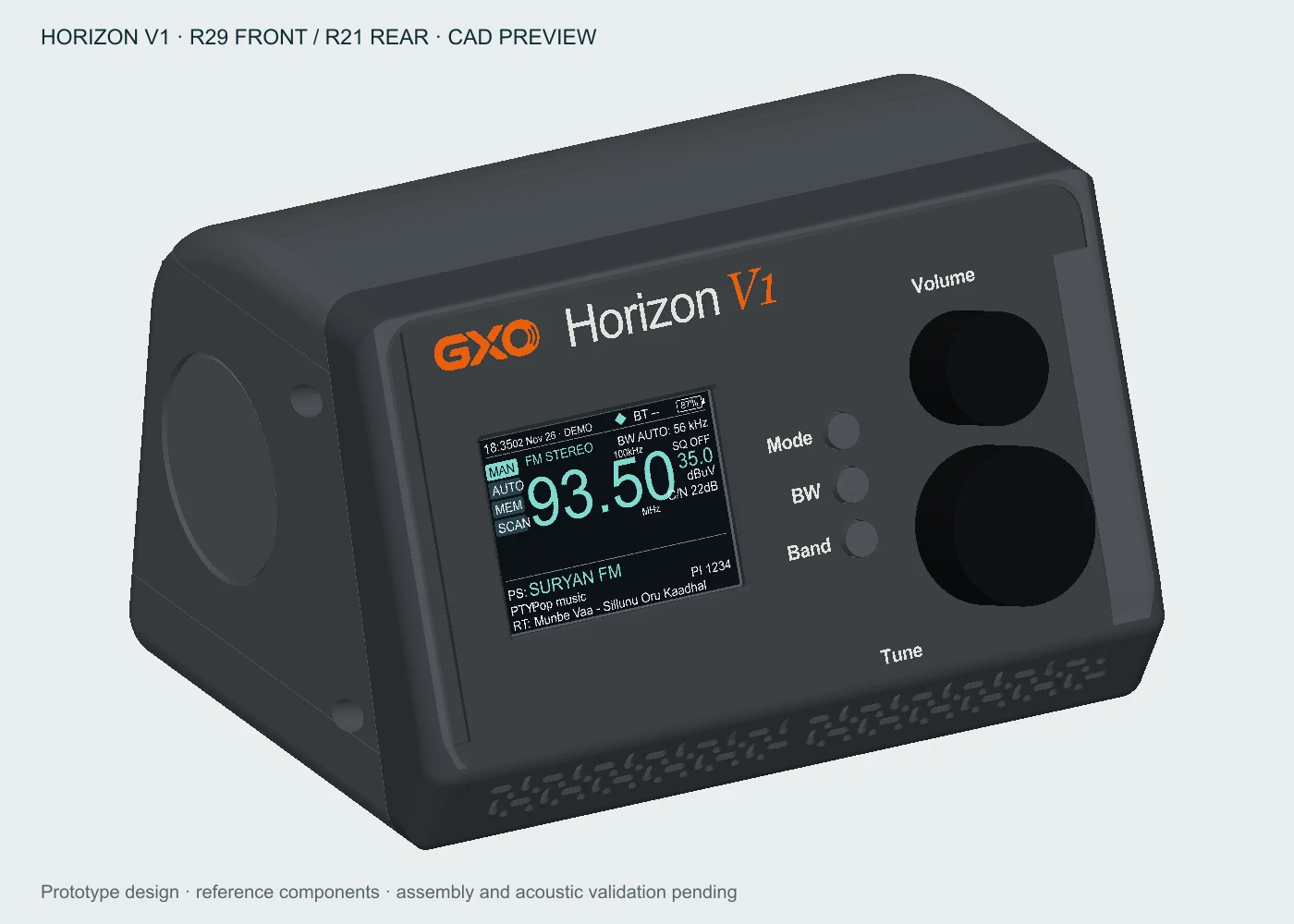
Choose a view · Drag to rotate · Scroll or pinch to zoom · Arrow keys rotate · +/− zoom
These are the selected components and intended functions of the custom Horizon RF34 design. Full hardware operation and performance remain subject to prototype validation.
The TEF6686 V205 tuner handles FM and AM reception with digital signal processing. Bandwidth controls and received RDS information let the listener explore what is on air.
A TI TPA6132A2 dedicated headphone amplifier provides a separate headphone drive path. The speaker path uses a PAM8406 stereo amplifier, so each listening output has a purpose-built stage.
The MAX17048 fuel gauge estimates battery state of charge using a battery model. The custom design uses this gauge for battery information; its hardware integration still requires prototype checks.
A BQ24074 power-path charger and TPS63070 buck-boost regulator manage the rechargeable supply. USB source detection distinguishes supported charging sources from an ordinary computer data port.
The custom RF34 design provides an RX8010SJ real-time clock and CR1220 backup. This is not a DP-666 T57 capability: hardware RTC retention is unsupported in that release. Manual time and timezone settings belong to the radio; optional RDS clock updates can remain off.
An ESP32-WROOM-32UE-N16 runs GXO’s custom application. Separate volume and tuning controls, three front buttons and a non-touch display keep everyday operation tactile.
A COMPACT BODY. A CONSIDERED PATH FOR SOUND.
Two 2.25-inch speaker reservations feed separate front sound ducts. A passive radiator on each side is paired with its own rear chamber. Separate lower sound tunnels lead toward the front grille. Speaker inserts use locally reinforced bosses with closed ends.
A removable top hood provides service access to the protected 21700 battery assembly. Separate radiator carriers, chamber lids and rear modules allow staged printing and assembly.
Explore the 3D assembly ↑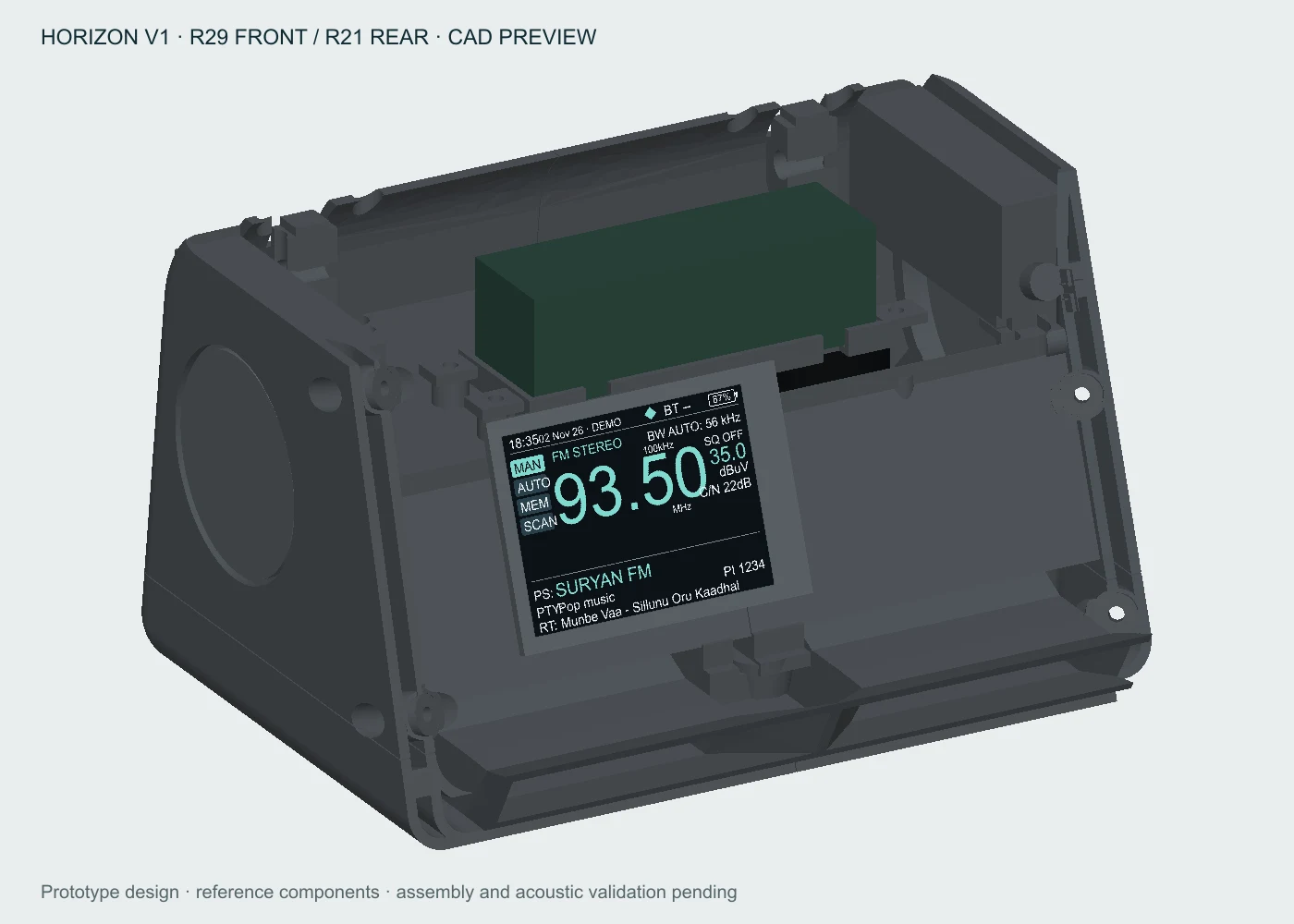
This model shows the R29 front with separate adhesive rim and the R21 rear split into two chambers and two lower sound tunnels. Use the single 3D viewer above to explore the assembled radio, separate its parts or inspect the RF34 PCB and display.
View-only meshes use the R29 front, R21 modular rear and RF34 PCB. Component models, the 25 mm volume / 35 mm tuning knob envelopes and display image are visual references. Speaker-insert seating and PR-mount fit were accepted on tested pieces. Complete assembly, battery and flex routing, sealing, radiator travel and acoustic response still need physical checks. The RDS screen is an illustration.
